The Secret Life of Clams by Fredericks Anthony D
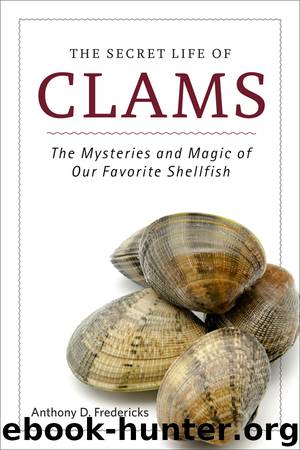
Author:Fredericks, Anthony D.
Language: eng
Format: epub
Publisher: Skyhorse Publishing
Published: 2014-01-01T05:00:00+00:00
Clams, just like other calcifiers, are able to create a layer of protein that attracts and attaches to the ionic calcium carbonate in seawater. Successive layers of calcium carbonate are attached to the protein along the open edge of a forming shell. As more and more layers of calcium carbonate are attached to the protein, new layers of protein are created on top of each calcium carbonate deposit (layer), thus attracting more material. With the extra weight of the shell, larvae no longer swim freely and settle to the bottom.
When they are large enough (approximately 0.2 mm), the larvae change into the juvenile stage by attaching to the substrate with thin byssal threads (like a spider spinning a web, only simpler). Clams don’t burrow at this stage; instead, they wrap their byssal threads around sand grains or shell fragments. The attachment is not permanent, however; a clam can release itself and move on to a different habitat more to its liking, should it prefer (like a college student changing apartments multiple times during the semester).
After twelve to fourteen days, the surviving larvae metamorphose into seed clams, and they finally begin to resemble little clams. They eventually develop a foot, and it is at this time that they often burrow into a suitable substrate where they remain mostly immobile. Just like four-year-old boys, most species of clams prefer a combination of mud and sand as a suitable substrate in which to live. Depending on the species, other suitable substrates may include pure sand, grave, and mud. For the most part, a clam’s favorite habitat is a shallow estuary where the current moves the water at a fairly leisurely pace. Clams don’t like fast-moving water (food spins by them too fast), nor do they like turbid waters. Since they feed exclusively on suspended food particles, excessive turbidity can clog their filtering system and eventually kill them.
There’s another critical element important to the growth and development of clams: water of the proper salinity. Clams grow best in seawater that contains about 20–30 parts per thousand (ppt) of salt.* In fact, a larval clam will not begin its metamorphosis to mature clam unless the salinity is at least 18–20 ppt, ensuring that the seed clam will not settle in an area where the salinity is unsuitable for adults.
When a seed clam finds an environment with proper salinity and adequate food supply, it becomes a permanent resident. The clam opens its shell, extends its short, hatchet-shaped foot, and uses it to dig into the substrate. The clam burrows under approximately one inch, and then extends its pair of siphons upward to draw in seawater and to expel waste. At a shell length of about seven to nine millimeters, the byssal gland is lost and the young clam becomes a certified juvenile.
FAST FACT: If you are interested in seeing a clam’s foot (as well as learning how to dissect a clam in the comfort of your own kitchen), check out the following website: www.biologyjunction.com/clam_dissection.htm.
Download
This site does not store any files on its server. We only index and link to content provided by other sites. Please contact the content providers to delete copyright contents if any and email us, we'll remove relevant links or contents immediately.
Better Homes and Gardens New Cookbook by Better Homes & Gardens(3595)
The Sprouting Book by Ann Wigmore(3592)
Trullo by Tim Siadatan(3430)
Super Food Family Classics by Jamie Oliver(3418)
Hedgerow by John Wright(3363)
Panini by Carlo Middione(3339)
Bread Revolution by Peter Reinhart(3142)
Sauces by James Peterson(3099)
Jam by Jam (epub)(3093)
Ottolenghi - The Cookbook by Yotam Ottolenghi(2946)
Oh She Glows Every Day by Angela Liddon(2780)
My Pantry by Alice Waters(2623)
Hot Sauce Nation by Denver Nicks(2495)
Veg by Jamie Oliver(2490)
The Culinary Herbal by Susan Belsinger(2479)
Meathooked by Marta Zaraska(2260)
The Art of Making Gelato by Morgan Morano(2255)
Wanderlust by Jeff Krasno(2254)
Basic Illustrated Edible and Medicinal Mushrooms by Jim Meuninck(2222)
